
Blasting Brick and Stone: Abrasives, Machines and Compressor Requirements
Removing paint, graffiti and surface deposits from brick or stone starts with understanding the material underneath. A setup that works well on sound, hard masonry can permanently damage softer brick, weathered sandstone or mortar joints.
This guide explains what to check, which abrasives to consider and how to match a blasting machine with the right compressed-air supply. CoolBlast supplies machines, compressors and complete packages for businesses carrying out this work.
Need help choosing a setup? Send us photographs, the approximate area and details of what you need to remove. Call 0330 127 2173 or email info@coolblast.co.uk.
1. Is blasting suitable for your brick or stone?
Start with the surface, its condition and the finish you want to retain. Removing a coating successfully is only half the job: the cleaned masonry must also remain sound.
Older, soft or handmade brick: Blasting can remove the outer face, expose softer material and change its appearance. Seek specialist advice where the face is already deteriorating.
Harder brick, including Accrington brick: A hard brick does not guarantee a damage-free result. Check the face, edges, mortar and any softer replacement bricks.
Sandstone and York stone: Condition and hardness vary. Watch for loose grains, laminations and loss of original texture.
Limestone and decorative stone: Protect fine detail and the original finish. A cleaning process can also become an unwanted texturing process.
Hard stone such as granite: The stone may resist abrasion, but polished finishes, inscriptions and surrounding joints may not.
Mixed masonry and lime mortar: The weakest part can determine the limits for the whole area. Test the joints as well as the brick or stone.
Historic England documents permanent brick-face damage from abrasive cleaning and warns that repeated cleaning can alter the appearance of stone. For significant historic fabric, get a conservation specialist involved before selecting a treatment. Historic England: graffiti removal and prevention.
Blasting is not always the best choice. Steam cleaning, a suitable paint-removal system or careful manual treatment may achieve the required result with less surface loss. Check any consent requirements before work on a listed building.
2. Identify what you need to remove
Paint: establish whether it is a thin coating, several layers or a thick, flexible finish. Test whether the coating releases before the masonry starts to erode. Assess old paint for hazardous constituents before disturbing it.
Graffiti: the visible coating may come off while staining remains within the pores. Trying to remove every trace by blasting can leave a damaged or visibly different patch.
Soot and surface dirt: these may need a gentler cleaning method than paint removal. Do not assume that abrasive blasting is necessary.
Mortar or cement deposits: the deposit can be harder than the surrounding masonry. More aggressive blasting may remove the surface you want to keep before removing the deposit.
Biological growth: investigate a suitable cleaning and treatment method before specifying an abrasive machine. Cleaning is not always necessary, and repeated treatment can damage historic masonry. Historic England: biological growth on masonry.
3. Choosing an abrasive
Select the least aggressive medium that achieves an acceptable result in a test. Hardness, particle shape, grade, feed rate and pressure all affect the outcome. Fine abrasive can still damage a soft surface.
Fine crushed glass: Coating removal and cleaning on suitable, sound brick and stone. Angular particles can cut the substrate. Trial the grade carefully; do not assume general-purpose glass is suitable for fragile masonry.
Sodium bicarbonate: Selected light coatings and gentle cleaning where a softer medium is appropriate. Check machine compatibility and how soluble residue will be removed from porous masonry. It is not automatically suitable for historic stone.
Fine calcite or dolomite: Specialist masonry cleaning with a compatible system. These are conservation-media options, not a blanket recommendation for every machine. Confirm feed compatibility, grade and cleaning method first.
Fine garnet or olivine: More demanding removal on robust masonry where trials justify stronger cutting action. Can erode soft brick, stone and mortar. Not a default choice for delicate restoration.
Glass bead is not interchangeable with crushed glass. Its rounded particles behave differently. Aluminium oxide and steel abrasives are not sensible default choices for decorative brick and stone cleaning.
Specify purpose-made blasting media with a consistent grade, check the Safety Data Sheet, and confirm that the machine can meter it through the selected nozzle. Do not use building sand or kiln-dried paving sand.
For more detail, see our abrasives guide for the Sabix 8 and Pressure Base.
4. Wet or dry blasting?
Wet or damp blasting introduces water to help suppress airborne dust. It can be useful on external brickwork and stone, provided water, slurry collection and protection of surrounding areas are planned.
Water does not make an unsuitable abrasive safe. Wet blasting can still erode faces, joints and detail, and it is not completely dust-free.
Open dry blasting avoids adding water but creates airborne dust and dispersed abrasive. Recovery blasting, such as the Pressure Base, captures abrasive and debris at a contact head and can reduce their spread where the head maintains good contact. Indoor work still needs particular attention to containment, extraction and exposure control. Do not assume dry blasting is the safer choice simply because a building is old or the work is indoors.
HSE's masonry blasting guidance favours wet/saturation or vacuum blasting as exposure controls. Choose the method through the job assessment, including the surface, coating, people nearby and cleanup requirements. HSE: abrasive blasting.
5. Potential machine setups
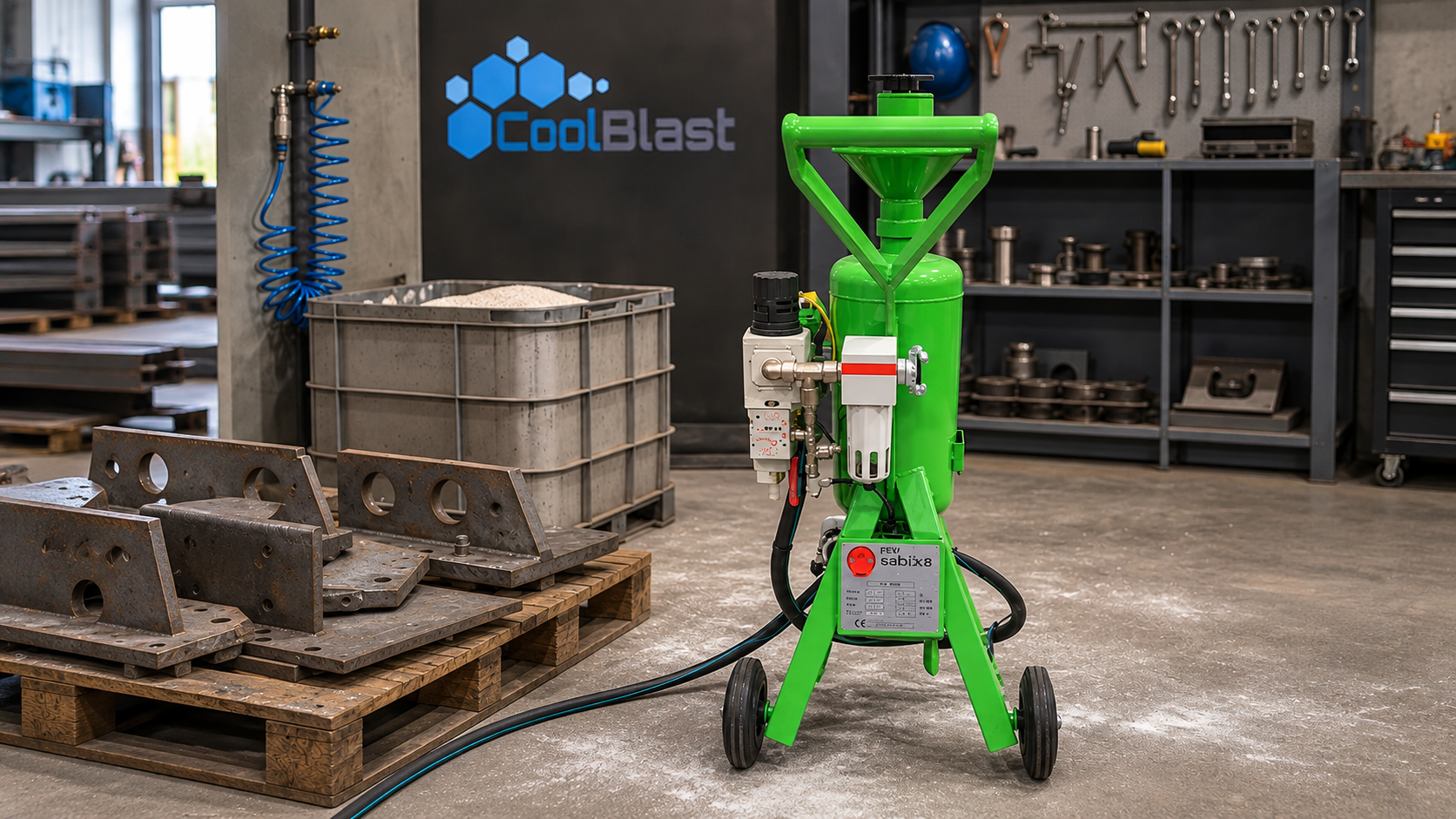
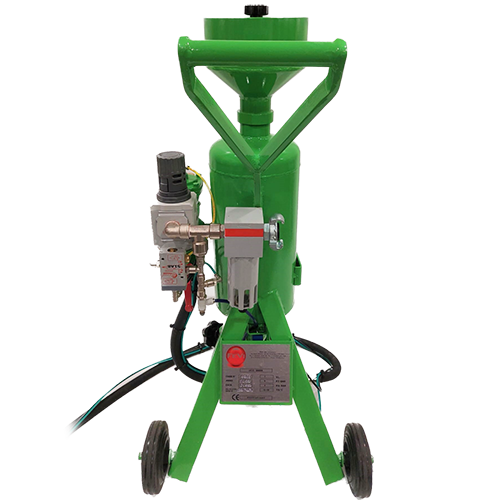
Compact setup: FEVI Sabix 8
For smaller areas, architectural features and controlled localised work, the Sabix 8 is a compact option with an 8-litre pot and a standard 3 mm nozzle.
The Base suits general controlled blasting. The VR adds pneumatic tank vibration and more precise abrasive regulation, useful for fine media. A water-humidification option is available; confirm what is included in the selected package.
A potential setup comprises the Sabix 8, a compressor matched to the chosen operating point, air treatment, compatible fine abrasive and the required dust controls and operator protection. Its smaller nozzle and pot favour portability and control; covering a large façade will involve more passes and refills.
See the FEVI Sabix 8.
Localised recovery setup: FEVI Pressure Base
The Pressure Base is an option for localised cleaning on relatively flat brickwork, regular stone surfaces and accessible architectural elements, particularly where containing dust and abrasive is important.
Its brush head works in contact with the surface while extraction draws abrasive and removed material back into the machine. A cyclone separates reusable abrasive from dust and waste, reducing abrasive spread and subsequent cleanup.
Surface contact is the main limitation. Deep mortar joints, rough or uneven stone, corners, recesses and decorative details can prevent effective containment. Test recovery across the actual surface, including joints; do not assume completely dust-free operation. FEVI identifies these applications and limitations in its construction equipment guide.
A potential package comprises the Pressure Base, a correctly sized compressor, dry-air treatment, compatible recyclable abrasive and an electrical supply for extraction. Choose the abrasive for the masonry first: suitability for recycling does not make a hard abrasive appropriate for delicate stone. Confirm the extraction and filtration arrangement for the dust and coating being removed.
The published pressure range starts at 2.5 bar, so it does not offer the Sabix 8's very-low-pressure range. Recovery controls debris; it does not prevent surface damage. For extensive façades or heavily textured masonry, a free-blasting setup may be more practical, subject to the surface trials and site controls.
See FEVI Pressure Base specifications.
Larger-area setup: Applied Aquablaster Xtreme 100
For contractors tackling larger walls and external areas, the Aquablaster offers a 100-litre abrasive capacity and wet/dry operation. Its larger working capacity can reduce refilling interruptions compared with a compact machine.
A potential package combines the Aquablaster, a suitably sized mobile compressor, air treatment, a matched nozzle, trial-approved abrasive and water/slurry controls. A compressor in the 175 CFM class is a useful starting point for discussing the package, with final sizing based on total air demand.
The larger machine is about working capacity and coverage. Blasting pressure must still be selected to suit the masonry. Do not assume that a larger pot makes a fragile surface suitable for blasting.
See the Applied Aquablaster Xtreme 100.
Conventional pressure-pot setup
An Applied 40- or 100-litre blast pot may be considered for suitable robust masonry where the required pressure and abrasive flow can be maintained and effective dust controls are in place.
Check the machine's minimum stable operating pressure, nozzle and media-metering capability. A general-purpose pot should not be assumed to offer the same fine control as a dedicated low-pressure system.
Pot capacity mainly affects refill frequency. Nozzle size and working pressure determine much of the air demand: a larger pot does not automatically require a larger compressor if the nozzle and operating conditions remain the same.
Browse our sandblasting machines.
6. How much compressed air is required?
Use actual delivered airflow at the required pressure — usually described as Free Air Delivery, or FAD. A compressor's displacement figure, tank capacity or maximum pressure does not tell you whether it can sustain blasting.
Sabix 8 air requirement
The published requirement is approximately 550 litres/minute, or 19.4 CFM, at 7 bar with the standard 3 mm nozzle. Lower-pressure work generally uses less air, but the actual requirement must be checked for the chosen setup. FEVI Sabix 8 VR specifications.
For planning, allowing 25% above 19.4 CFM gives approximately 24.3 CFM FAD before any additional air demand. This is a sizing allowance, not a manufacturer-issued complete-package requirement. Add air for pneumatic accessories and an air-fed helmet where applicable, and check compressor duty cycle.
A compressor advertised as 18 or 20 CFM displacement should therefore not be assumed to support continuous operation at that published 7 bar point.
Pressure Base air and electrical requirements
FEVI publishes 700–2,000 litres/minute, approximately 25–71 CFM, at 7 bar, depending on configuration and operating conditions. Its listed operating pressure range is 2.5–7.8 bar. Confirm the exact nozzle and configuration before selecting the compressor; do not size a complete package from the bottom of this broad airflow range alone.
The extraction unit also needs 220–240V, 50 Hz single-phase power and is rated at 1,500W. This is separate from the compressed-air supply, and its published suction airflow is not the compressor requirement. Allow for other compressed-air users and suitable compressor capacity above the confirmed demand.
Aquablaster air requirement
CoolBlast lists 90 CFM minimum and operation optimised around 175 CFM for the Aquablaster. Treat these as package-selection reference figures: confirm nozzle, pressure, water-pump demand and any breathing-air demand before choosing the compressor. Aquablaster specifications.
Why nozzle size matters
These indicative figures show air consumption for conventional pressure-blast nozzles. They are not prescribed masonry-cleaning pressures or minimum compressor sizes.
3.2 mm / ⅛ inch nozzle: approximately 10 CFM at 2.8 bar / 40 psi, or 22 CFM at 6.9 bar / 100 psi.
4.8 mm / 3⁄16 inch nozzle: approximately 23 CFM at 2.8 bar / 40 psi, or 49 CFM at 6.9 bar / 100 psi.
6.4 mm / ¼ inch nozzle: approximately 41 CFM at 2.8 bar / 40 psi, or 85 CFM at 6.9 bar / 100 psi.
7.9 mm / 5⁄16 inch nozzle: approximately 67 CFM at 2.8 bar / 40 psi, or 140 CFM at 6.9 bar / 100 psi.
9.5 mm / ⅜ inch nozzle: approximately 93 CFM at 2.8 bar / 40 psi, or 194 CFM at 6.9 bar / 100 psi.
Special nozzles and machine designs can differ; use their own specifications where available.
For example, an approximately 85 CFM nozzle demand plus 25% planning allowance is about 106 CFM, before other air users. A worn nozzle can draw more air, so leave capacity and inspect it regularly.
Size hoses and couplings for the flow and run length. Restrictive fittings cause pressure loss that cannot simply be cured by quoting a bigger compressor. Check pressure while blasting, not only with the nozzle stopped.
7. Keep the air dry and the supply consistent
Fine media can clump and feed poorly when moisture enters the pot. Depending on conditions, a package may need an aftercooler, separator, suitable filtration and a dryer.
An aftercooler cools the air so water can condense; a separator removes liquid water. A dryer reduces remaining moisture to a specified dew point. They perform different jobs and must be rated for the airflow, pressure and temperature involved.
Wet blasting still needs suitable air treatment: controlled water addition at the nozzle is different from unwanted moisture in the abrasive supply.
A receiver provides a short reserve; it cannot compensate for insufficient continuous compressor output. Check duty cycle and the available electrical supply when choosing an electric compressor. Petrol and diesel units must operate outside, with exhaust kept away from occupied areas and breathing-air intakes.
See our compressor range and low-pressure blasting guide.
8. Establish the settings with a test patch
There is no universal safe pressure for brick or stone. A machine's adjustment range is not a recommended operating range for your wall.
Choose a representative, discreet area that includes a mortar joint and any vulnerable detail.
Use a trial-approved fine or soft medium and begin at the lowest stable setting appropriate to the machine and proposed method.
For free blasting, keep the nozzle moving and maintain a controlled stand-off distance. With a recovery head, maintain the contact required by the manufacturer and check extraction remains effective. Avoid dwelling on one spot, particularly edges or joints.
Change one setting at a time. If the coating remains while the masonry starts to erode, stop and reconsider the method.
Remove residue appropriately and inspect the texture, colour, edges and joints. Let a wet patch dry before judging the result.
Agree the finish, record the settings and repeat trials where the material or coating changes.
Stop if you see new pitting, loss of the brick face, loosened stone grains, rounded detail or eroding joints. Do not chase a uniformly “new” appearance at the expense of the original surface.
Time the approved trial to estimate production. Include access, masking, refilling and cleanup when calculating the job; a machine's headline coverage rate is not a promise for painted masonry.
9. Dust, protection and cleanup
Brick and stone can release respirable crystalline silica even when the abrasive itself has low crystalline-silica content. Old coatings may introduce additional hazards.
Plan the COSHH assessment, containment, exclusion area and waste collection before starting. HSE CN7 specifies an air-fed abrasive-blasting helmet with an assigned protection factor of at least 40 and breathing-quality air for the operator. Ordinary compressor air with a basic water trap is not automatically suitable for breathing.
Provide appropriate clothing, gloves, footwear and hearing protection. Collect spent abrasive and slurry, assess contamination and arrange suitable disposal; do not wash it into surface-water drains. See HSE's abrasive blasting guidance.
10. Let us help match the equipment to your work
Whether you need a compact machine for smaller restoration jobs or a larger setup for regular wall and façade work, CoolBlast can help match the machine, compressor, nozzle and air treatment.
Send us:
Photographs of the surface, including close-ups of the coating and joints.
The type of brick or stone, if known, and its condition.
What you want to remove and the finish you want to retain.
The approximate area and whether the work is indoors or outdoors.
Site access, water and power availability.
Your compressor model and its delivered airflow, if you already have one.
Call: 0330 127 2173
Email: info@coolblast.co.uk
Send photographs on WhatsApp
We supply blasting machines and compressors, with UK support and finance options, and can quote for a package around your requirements.
