
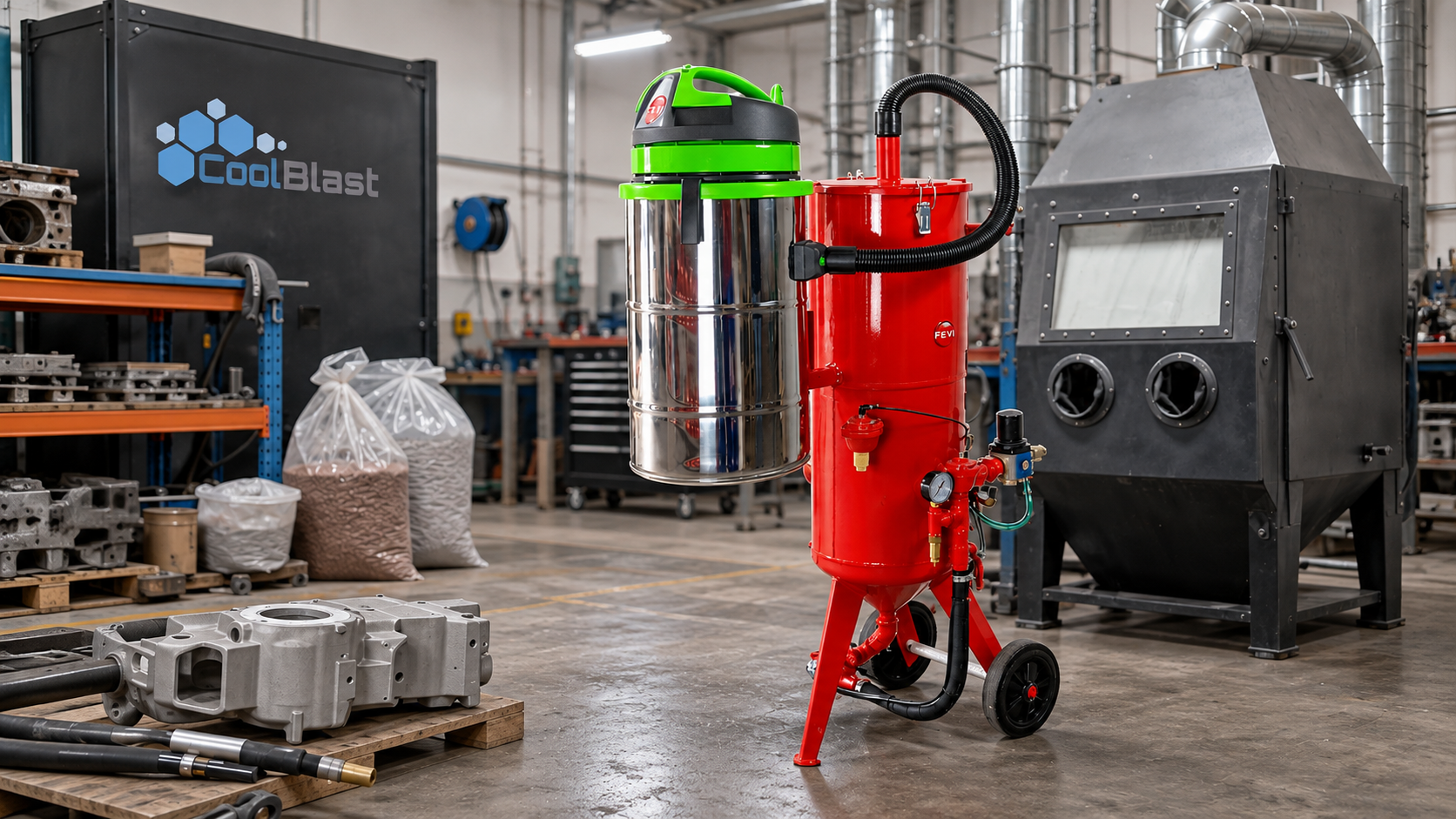
What Is an Abrasive Recovery Blasting Machine?
Abrasive recovery blasting combines pressure blasting with vacuum extraction, allowing abrasive and dust to be recovered directly at the blasting head.
This guide explains how recovery blasting works, where it is most useful, its advantages and limitations, and how it compares with conventional open blasting.
1. What is abrasive recovery blasting?
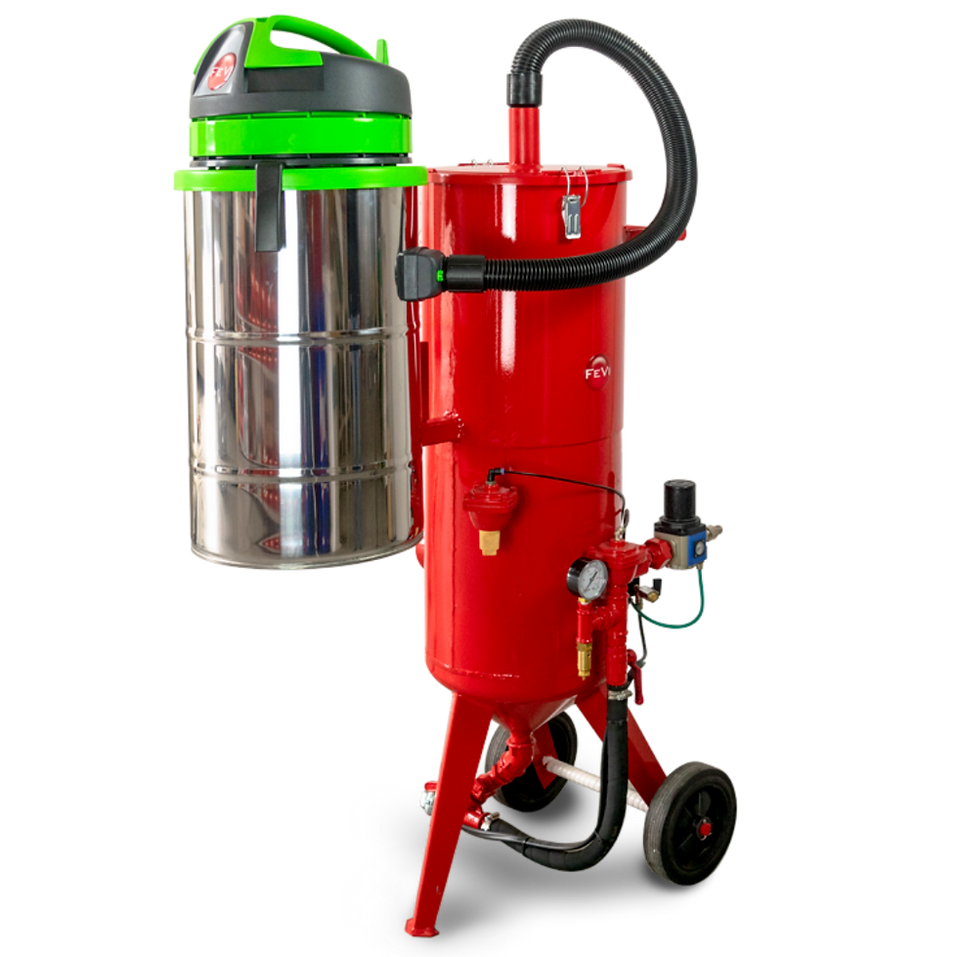
An abrasive recovery blasting machine combines a pressure blast pot with a vacuum recovery system.
Instead of allowing abrasive and dust to spread freely around the working area, the blasting head is held against the surface.
A surrounding brush or seal helps contain the abrasive while the extraction system simultaneously pulls used media, dust and removed contamination away from the surface.
Suitable abrasive can then be separated and reused.
This makes recovery blasting particularly useful where dust, mess and clean-up need to be kept under control.
2. How does an abrasive recovery blaster work?
The process can be broken down into four stages:
Blast
Compressed air propels abrasive from the pressure pot through the nozzle and onto the surface.
Recover
The recovery head surrounds the blast area and extracts the abrasive and debris as the operator works.
Separate
A cyclone or separation system removes fine dust and contamination from reusable abrasive.
Reuse
Suitable media is returned to the blasting process, helping reduce abrasive consumption and waste.
The result is a much more contained blasting process than conventional open blasting.
3. What are the main benefits?
Recovery blasting can offer several advantages:
Reduced abrasive spread
Lower airborne dust
Less workshop clean-up
Reuse of suitable blasting media
Reduced abrasive consumption
Less preparation and screening
Better suited to indoor environments
Controlled localised blasting
Useful where blasting cabinets are impractical
Cleaner working conditions around machinery and equipment
The biggest benefit is often not blasting speed, but being able to carry out abrasive blasting in places where open blasting would create too much mess.
4. Where does recovery blasting work best?
Recovery blasting is particularly effective on surfaces where the blasting head can maintain good contact.
Typical applications include:
Flat steel panels
Fabricated steel sections
Tanks and vessels
Weld seams
Machinery housings
Vehicle and trailer panels
Industrial equipment
Stone slabs
Large components that cannot fit inside a blasting cabinet
Localised rust or coating removal
Flat and gently curved surfaces are generally the easiest to work on.
5. Where does recovery blasting struggle?
The recovery head needs to sit reasonably close to the surface to contain and recover the abrasive.
That means it can be less effective on:
Tight corners
Deep recesses
Highly irregular components
Complex fabricated shapes
Inside small cavities
Narrow channels
Areas where the brush cannot maintain contact
For these applications, conventional free blasting may be faster and easier.
Some recovery machines can also be converted for open blasting, giving the operator the option to switch between the two methods.
6. Recovery blasting vs open blasting
Recovery blasting
Best when:
Cleanliness matters
Blasting indoors
Treating localised areas
Abrasive recovery is important
You want to reduce clean-up
Screening the whole area would be difficult
Open blasting
Best when:
Maximum blasting speed is required
Treating large areas
Working on complex shapes
Access is difficult
Abrasive containment is already in place
Neither system is universally better.
Recovery blasting gives you control and containment, while open blasting usually gives you speed and flexibility.
7. What abrasives can be recovered?
The best media for recovery blasting are usually abrasives that are durable enough to be reused.
Common options include:
Aluminium oxide
Hard, aggressive and reusable. Good for rust, paint, corrosion and steel preparation.
Glass bead
Reusable and less aggressive. Suitable for cleaning and finishing metals.
Garnet
Good cutting performance for coatings and corrosion, although reuse depends on the grade and how much it breaks down.
Vegetable-based media
Useful for more delicate surfaces and restoration work.
Some softer abrasives, such as sodium bicarbonate, break down much more quickly and therefore offer less benefit from the recovery system.
The correct abrasive depends on the surface, coating and finish required.
8. Does recovery blasting eliminate dust?
No.
Recovery blasting can greatly reduce airborne dust and abrasive spread, but it should not be described as completely dust-free.
Recovery performance depends on factors including:
Surface shape
Condition of the recovery brush
Vacuum performance
Operator technique
Abrasive type
Nozzle position
Some dust may still escape, particularly when working on uneven surfaces or around edges.
Appropriate PPE and ventilation may still be required.
9. Can abrasive really be reused?
Yes, depending on the abrasive and contamination being removed.
A cyclone separates heavier reusable abrasive from lighter dust and debris.
This can reduce abrasive consumption considerably compared with open blasting.
However, abrasive does gradually break down and become contaminated, so it cannot be recycled indefinitely.
Regular inspection and replacement of media is still necessary.
10. What compressor do you need?
Recovery blasting still relies on compressed air, so correct compressor sizing is important.
The required airflow depends on:
Nozzle diameter
Blasting pressure
Machine design
Hose length
Pressure losses
Required duty cycle
For example, the FEVI Pressure Base operates across roughly 25–71 CFM at 7 bar, depending on setup and operating conditions.
A compressor should be sized around actual delivered airflow at working pressure, not simply receiver size or advertised displacement.
If the compressor cannot maintain the required airflow, blasting pressure and productivity will fall.
11. Why dry compressed air matters
Moisture can cause problems in any abrasive blasting system.
Condensation can:
Cause abrasive to clump
Reduce media flow
Block hoses or valves
Affect abrasive separation
Contaminate the surface
For professional setups, a moisture separator, aftercooler or refrigerated air dryer may be worth adding.
This is particularly important when using fine reusable abrasives.
12. Recovery blaster or blasting cabinet?
A recovery blaster can be a good alternative where the component is too large or too difficult to place inside a cabinet.
A cabinet is ideal for:
Small components
Repetitive production work
Fully enclosed blasting
Controlled workshop environments
A recovery blaster is often better for:
Large fabricated components
Fixed machinery
Tanks
Structural sections
Panels
Equipment that cannot be moved easily
In many workshops, the two systems actually complement each other rather than directly replace one another.
13. Typical industries
Abrasive recovery blasting can suit:
Metal fabrication
Engineering
Welding
Industrial maintenance
Vehicle repair
Trailer repair
Marine maintenance
Restoration
Stone and masonry work
Manufacturing
Plant maintenance
Workshops carrying out localised surface preparation
14. The FEVI Pressure Base
The FEVI Pressure Base combines a 24 litre pressure blast pot with abrasive recovery, cyclone separation and vacuum extraction.
It is designed for professional users who need to remove rust, paint, coatings and contamination while keeping abrasive spread and clean-up under control.
It is particularly suited to:
Fabrication workshops
Weld cleaning
Industrial maintenance
Machinery
Steel components
Localised corrosion
Restoration work
Indoor blasting
An optional free-blast conversion kit allows the machine to be used conventionally where the recovery head cannot maintain contact with the surface.
Final Thoughts
Recovery blasting combines pressure blasting and vacuum extraction.
Abrasive is recovered directly at the blasting head.
Suitable abrasive can be separated and reused.
It greatly reduces dust, abrasive spread and clean-up.
It works best on flat and gently curved surfaces.
Complex shapes and tight corners can be more difficult.
It does not completely eliminate dust.
Reusable abrasives such as aluminium oxide and glass bead work particularly well.
Correct compressor sizing and dry compressed air remain important.
👉 Need help choosing a recovery blasting setup?
