
A practical review of Rotair, Applied, Avelair, Atlas Copco, KAESER, Bobcat and Airmec compressors.
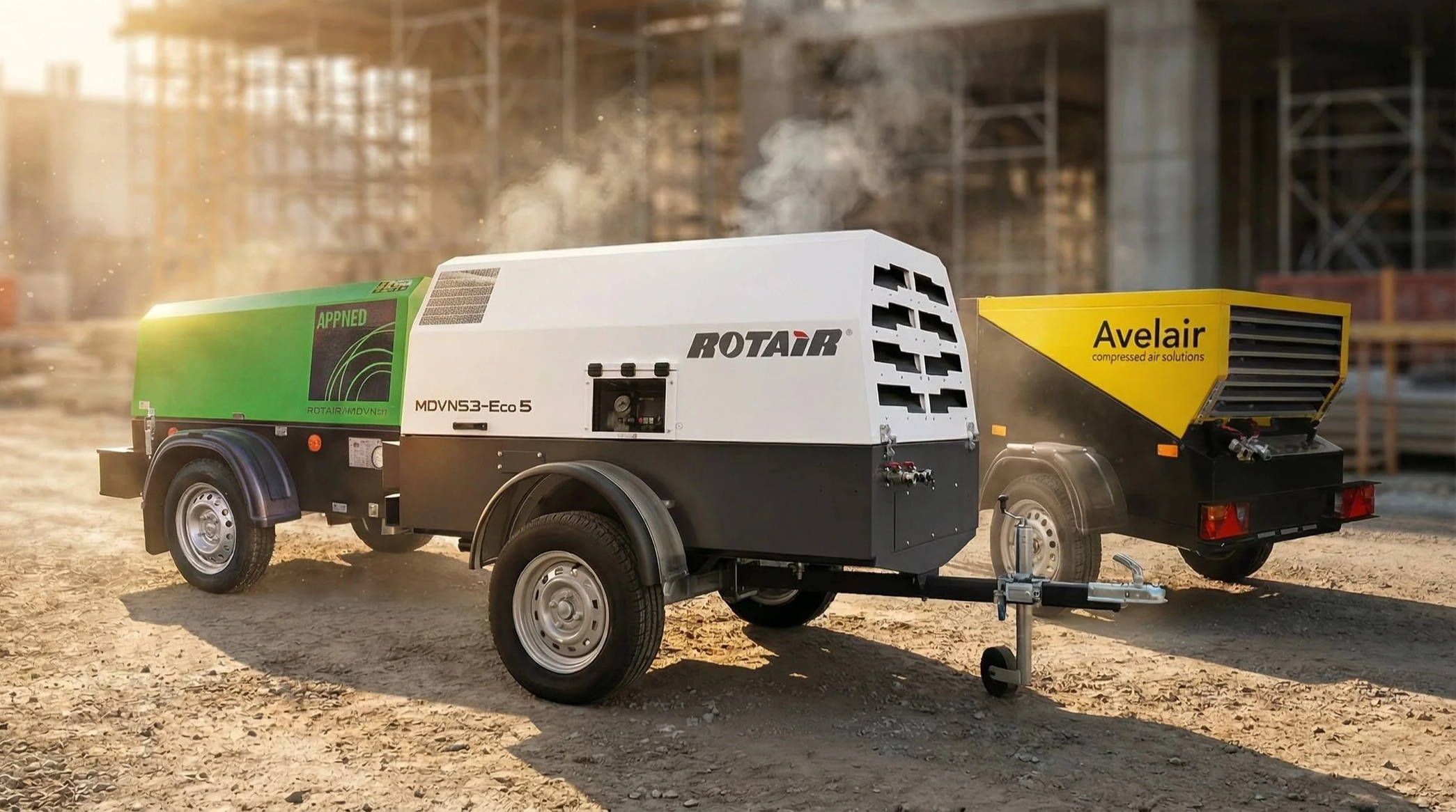
By CoolBlast | Specifications checked 30 October 2026
For mobile sandblasting with a conventional pressure blast pot, the 175–200 CFM compressor class is a useful starting point for a shortlist. Smaller nozzles and low-pressure restoration work can use less air, while larger nozzles can require considerably more.
The right compressor depends on the nozzle, pressure at the nozzle and total air demand. Buying on maximum pressure or advertised CFM alone can leave you with a machine that struggles to maintain your chosen blasting setup.
This specification-based review compares compressors from the CoolBlast range with alternatives from other manufacturers. Our verdicts assess suitability from published specifications rather than a hands-on comparative test. The selection is not a ranking of UK sales or market share.
Sandblasting compressor comparison
| Compressor | Published airflow | Our suggested role |
|---|---|---|
| Rotair MDVN 30 Eco5 | 104 CFM at 7 bar | Smaller nozzles and lighter mobile work |
| Avelair AP3000 | 105 CFM at 7 bar | Compact diesel alternative for smaller setups |
| Rotair MDVN 53 Eco5 | 177 CFM at 7 bar | General contractor shortlist |
| Applied PDC175 | 175 CFM at 7 bar | Contractor package with integrated air treatment |
| Atlas Copco XAS 88-7 | 175 CFM at 7 bar | Alternative in the same airflow class |
| KAESER MOBILAIR M59 | Up to 195 CFM, depending on pressure version and setting | Work requiring configurable pressure and air treatment |
| Bobcat PA7.5 | Approximately 180 CFM at 7 bar | Another contractor-class alternative |
| Rotair MDVN 83 Eco5 | 283 CFM at 7 bar | More airflow for demanding work |
| Airmec TTS 34110/900 | Quoted maximum 900 L/min, approximately 31.8 CFM* | Compatible small-nozzle, low-pressure equipment |
* The Airmec figure is not confirmed free air delivery at blasting pressure and is not directly comparable with the diesel figures. Specifications and fitted options vary by version.
How much CFM does a sandblasting compressor need
Start with your nozzle manufacturer's consumption chart. As an example, Clemco publishes the following air requirements for new nozzles at 100 PSI, approximately 6.9 bar, measured at the nozzle. [1]
| Nozzle | Approximate bore | Nozzle air consumption at 100 PSI |
|---|---|---|
| No. 4 | 6.4 mm or 1/4 inch | 81 CFM |
| No. 5 | 7.9 mm or 5/16 inch | 137 CFM |
| No. 6 | 9.5 mm or 3/8 inch | 196 CFM |
| No. 7 | 11.1 mm or 7/16 inch | 254 CFM |
Figures are for new nozzles at 100 PSI (approximately 6.9 bar) at the nozzle. These are nozzle-only figures: allow for other air users, nozzle wear and pressure losses when sizing the complete system. Source: Clemco air consumption chart .
These are nozzle-only figures. Allow for other air users, any dryer purge demand and nozzle wear, and ensure sufficient pressure remains after losses through hoses, fittings and treatment equipment.
For perspective, Clemco's separate complete-system guide allows for helmet air and a 50% reserve. It gives a 236 CFM sizing figure for a No. 5 nozzle. That is why a 175 CFM compressor should not automatically be described as sufficient for every No. 5 setup. [2]
Check free air delivery, or FAD, at your required operating pressure. A large receiver provides temporary stored air; sustained blasting still depends on the compressor's output.
Rotair MDVN 30 Eco5
Our verdict: a sensible compact diesel option for smaller blasting setups.
Rotair publishes 2,950 L/min, approximately 104 CFM, at 7 bar for the MDVN 30 Eco5. It is worth considering where a smaller nozzle suits the job and a larger compressor would add unnecessary size. [3]
Its limitation is airflow reserve. A No. 4 nozzle consuming 81 CFM at 100 PSI leaves relatively little capacity for the rest of the system. Choose it around a confirmed nozzle and pressure requirement, particularly if continuous production matters.
Ask for the blasting configuration with appropriate aftercooling and moisture separation. [4]
Avelair AP3000
Our verdict: a useful alternative in the compact diesel class.
The AP3000 is rated at 105 CFM at 7 bar, falling to 75 CFM at 10 bar. That pressure-related reduction matters when comparing it with compressors advertised simply as “105 CFM”. [5]
We would shortlist it for smaller mobile blasting systems where its output matches the nozzle. It offers less scope for moving to a larger nozzle than a 175–200 CFM machine.
CoolBlast's listed AP3000 package includes an aftercooler and cyclonic water separator. Confirm these on the quotation, as Avelair also offers configurations with optional aftercooling. [5][6]
Rotair MDVN 53 Eco5
Our verdict: one of our first options to compare for general mobile blasting work.
The MDVN 53 Eco5 is rated at 177 CFM at 7 bar. Rotair also quotes 175 CFM at 10 bar, giving it useful flexibility where the wider system requires higher delivery pressure. [3]
That makes it a worthwhile comparison with machines whose headline airflow is available only at 7 bar. Higher nozzle pressure also increases air consumption, so the complete setup still needs sizing.
Choose the required air-treatment specification explicitly. For contractors planning larger nozzles or additional air users, compare the MDVN 83 before committing. [4]
View the Rotair MDVN 53 Eco5 at CoolBlast.
Applied PDC175
Our verdict: worth shortlisting when you want the compressor and air treatment in one package.
The Applied PDC175 delivers 175 CFM at 7 bar. CoolBlast's listed specification includes an aftercooler with automatic condensate drainage, reducing the need for a separate external cooling unit. [7][8]
The quoted package lists two 3/4-inch outlets. Check the outlet, coupling and supply-hose arrangement against the blast system's requirements, especially with long hose runs. A large hose cannot remove a restriction further upstream.
Compare the delivered package, connections and treatment equipment alongside the airflow figure. Confirm the requirements of your complete blasting circuit before selecting this class of compressor. [8][12]
View the Applied PDC175 at CoolBlast.
Atlas Copco XAS 88-7
Our verdict: a relevant alternative to compare with the Rotair MDVN 53 and Applied PDC175.
Atlas Copco rates the XAS 88-7 at 175 CFM FAD at 7 bar and identifies abrasive blasting among the applications for its small mobile compressor range. [9]
It belongs on a contractor's shortlist where that airflow class suits the work. Compare the specified air treatment and delivered price with the other options, rather than assuming every XAS 88 has the same equipment.
Pay attention to the model suffix. The XAS 88-7 and XAS 88-10 PACE have different pressure capabilities. Confirm aftercooler options and performance for the exact machine quoted. [9]
KAESER MOBILAIR M59
Our verdict: a strong specification to consider when pressure flexibility and air-treatment options matter.
KAESER advertises the M59 with output up to 195 CFM. Its pV control allows pressure adjustment, with available operating ranges extending to 14 bar, depending on version. [10]
The appeal is the ability to configure the machine for different work. Optional treatment equipment includes aftercooling, filtration and reheating.
Request the flow curve for the quoted pressure version. Maximum airflow and maximum pressure are separate figures. Also compare the weight of the exact chassis and enclosure configuration, as versions differ. [10]
Bobcat PA7.5
Our verdict: another worthwhile comparison in the contractor compressor class.
Bobcat's European brochure lists the PA7.5 at 5.0 m³/min, approximately 180 CFM in its published figures, at 7 bar. An aftercooler is an available option. [11]
Its airflow puts it in broadly the same comparison group as the XAS 88-7, PDC175 and MDVN 53. The deciding factors should include the actual treatment package, local servicing arrangements and delivered quotation.
As with the other compressors in this group, nozzle-only demand is not enough to establish suitability. Specify the whole air system before choosing.
Rotair MDVN 83 Eco5
Our verdict: the model to compare when you need more capacity than the 175–200 CFM class.
The MDVN 83 Eco5 delivers 283 CFM at 7 bar, giving considerably more airflow than the smaller contractor models in this review. Rotair identifies sandblasting among its intended applications. [3][13]
We would consider it for larger blasting jobs, greater reserve or a planned move to a larger nozzle. Its additional size and transport requirements need to fit your business.
Even at 283 CFM, a large nozzle and shared breathing-air demand can use the available capacity quickly. Size it against your intended working pressure and reserve requirement.
View the Rotair MDVN 83 Eco5 at CoolBlast.
Airmec TTS 34110/900
Our verdict: a specialist option for compatible low-pressure blasting equipment.
The petrol-powered TTS 34110/900 has a manufacturer-quoted maximum flow of 900 L/min, approximately 31.8 CFM, and twin 17-litre receivers. [14]
It is an option to assess for compact equipment such as a suitably configured FEVI Sabix 8. Confirm delivered airflow, nozzle size, pressure and permitted duty cycle before expecting continuous blasting.
The published maximum-flow figure should not be treated as verified FAD at working pressure. Its role is controlled work with an appropriately matched small nozzle; it has much less airflow capacity than the diesel models above.
View the Airmec TTS 34110/900 at CoolBlast.
What to compare before buying
Air treatment: An aftercooler and separator remove condensed water, but do not guarantee completely dry or oil-free air. Confirm whether additional drying or filtration is needed for the abrasive, finish and conditions. [10]
Connections and hoses: Check the complete path from the compressor to the blast pot. Undersized hoses, restrictive couplings and treatment equipment can cause pressure loss. Follow the blast equipment manufacturer's supply-line guidance. [12]
Running costs and support: Ask for fuel consumption at a stated load, service intervals, warranty terms and local parts support. Compare these using equivalent working conditions.
The delivered package: Establish what is included in the quotation, including air treatment, chassis, hoses, delivery and VAT. A lower initial price can become less attractive when essential equipment is added.
Frequently asked questions
Is a 175 CFM compressor enough for sandblasting
It can suit a correctly matched single-nozzle setup. Check demand at your actual nozzle pressure and add other air users and an appropriate reserve. A 175 CFM rating alone does not establish suitability.
Can I use a small petrol compressor for sandblasting
Yes, with compatible low-air-demand equipment. Confirm actual delivered airflow and duty cycle. A small compressor may require pauses if demand exceeds its sustainable output.
Is 7 bar enough for sandblasting
Suitability depends on the surface, abrasive and blasting system. Measure pressure while blasting at the nozzle, because the compressor gauge does not show downstream losses.
Does a bigger blast pot need a bigger compressor
Pot capacity mainly affects how much abrasive you can load between refills. Compressor sizing depends primarily on nozzle demand, working pressure and the other equipment using air.
What about used Doosan or Ingersoll Rand compressors
Compare the exact model and specification. Check operating hours, service history, air delivery under load and fitted air treatment. A familiar badge does not establish the condition or suitability of an individual used machine.
Final thoughts
Our starting shortlist would be the Rotair MDVN 30 or Avelair AP3000 for smaller systems, and the Rotair MDVN 53 or Applied PDC175 for a contractor setup requiring more airflow. Atlas Copco, KAESER and Bobcat provide relevant alternatives to compare. The MDVN 83 deserves consideration when additional capacity is central to your work.
At CoolBlast, we can help match the compressor, blast pot, nozzle and air treatment. Send us your nozzle size, intended pressure and application so we can recommend a suitable package.
Explore sandblasting and compressor packages, call 0330 127 2173, or email info@coolblast.co.uk.
Sources
1. Clemco nozzle air consumption chart.
2. Clemco complete blast system air volume estimates.
3. Rotair European portable compressor brochure.
4. Rotair MDVN range and blasting configurations.
5. Avelair mobile compressor range.
6. CoolBlast Avelair AP3000 supplied specification.
7. Applied 175 CFM compressor.
8. CoolBlast Applied PDC175 supplied specification.
9. Atlas Copco UK small mobile compressor range.
10. KAESER M59 product information and manufacturer brochure.
11. Bobcat European small compressor brochure.
12. Clemco compressor air line sizing guide.

